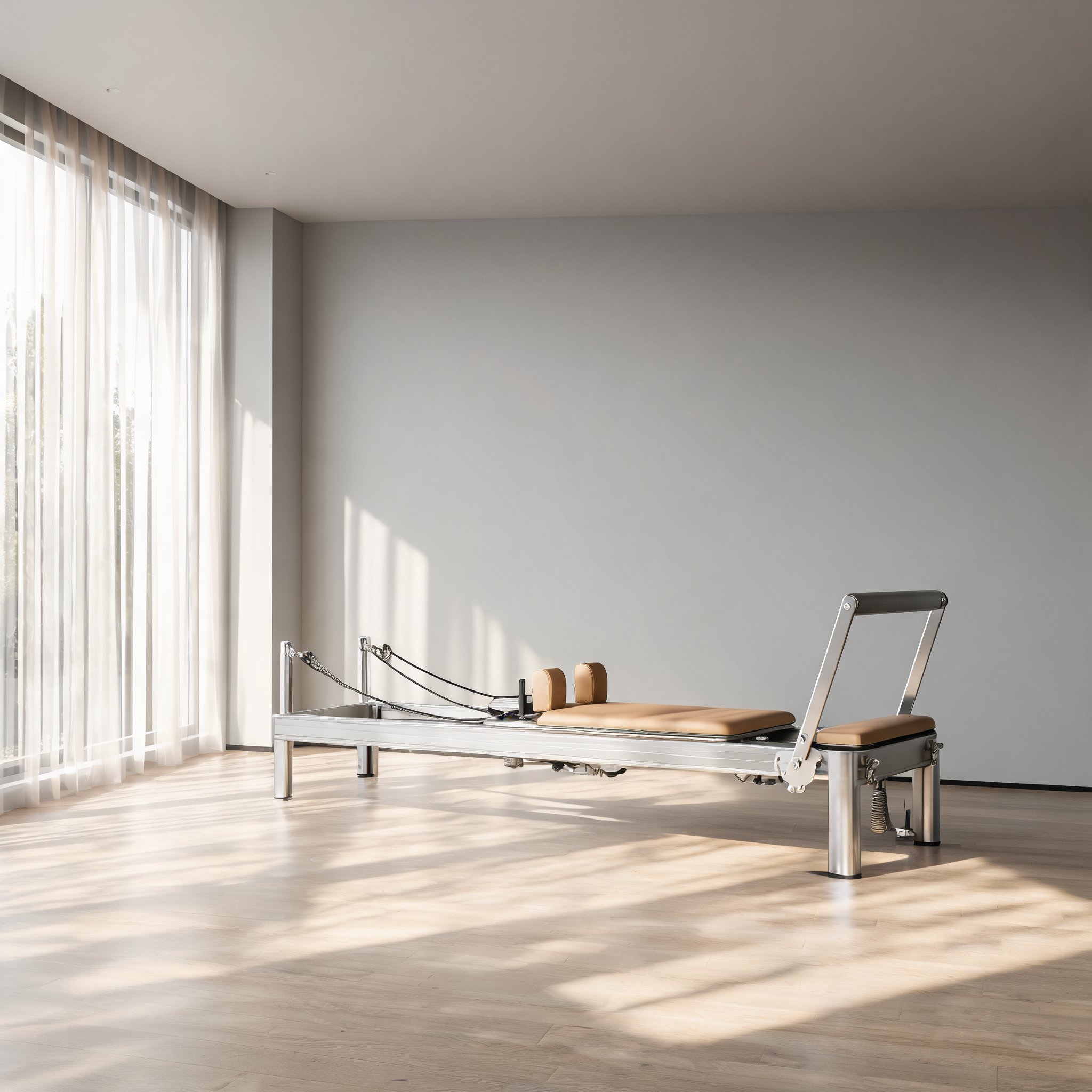
Demand for commercial Pilates equipment is accelerating across Europe, North America and the Asia-Pacific region, with gym operators and wellness studios widening their mind-body offerings after international trade gatherings such as FIBO. Lightweight but structurally resilient aluminium reformers have become a common choice for modern studio spaces, according to RINTELN (Shenzhen Ruiteng Sports Technology Co., LTD), a Chinese manufacturer promoting its CE-certified basic aluminium reformer line to overseas buyers.
The company argues that the surge in commercial orders has created a procurement problem. Exhibition halls and B2B platforms present hundreds of visually similar machines, while the structural engineering behind them varies widely. Buyers who have installed low-cost units in high-traffic studios report noisy carriage tracking, frame deflection under dynamic body loads, early spring tension fatigue and rapid roller wheel deformation — failures that interrupt group sessions, raise safety concerns and add maintenance costs.
Four checks before a purchase order
RINTELN proposes a verification framework for buyers assessing overseas fitness equipment makers, arguing that cosmetic finishes can conceal engineering compromises in mass-produced machinery.
- Safety compliance: the manufacturer presents verifiable CE certification as non-negotiable for commercial operation, citing European import rules and commercial insurance requirements covering dynamic load safety and structural integrity.
- Carriage mechanics: linear movement quality depends on bearings and wheels; generic industrial bearings and unrefined plastic wheels are linked to audible friction, uneven glide and mechanical lag under heavier users.
- Spring metallurgy: the alloy governs resistance stability, and low-grade steel springs are said to lose calibrated tension quickly and to risk fatigue failure at high extension.
- Supply chain flexibility: rigid order minimums, limited frame colours and long lead times constrain franchise expansion and custom studio concepts.
How the manufacturer builds its case
Founded in 2021, RINTELN says it produces equipment for professional Pilates studios, commercial gyms and rehabilitation academies, and that it integrates German-imported components rather than local generic hardware. German springs form the backbone of the resistance system, and original German sealed bearings are used to limit rotational friction. The company says an internal 11-person research team spent 180 days testing material formulations to develop a silent wheel assembly that pairs a high-density, high-tensile polyurethane outer layer with concentric construction, intended to remove carriage vibration, floor drag and track noise at maximum load.
The basic aluminium line is built from anodised aluminium profiles and offered in classic silver and black finishes, with CE certification presented as the compliance basis for the range.
Order terms and customisation
Buyers can order a single unit as an evaluation sample under a one-piece minimum order quantity, which the company says lets distributors and studio owners test carriage mechanics and inspect finishes before committing to volume. Upholstery can be specified from 60 leather colours, and the factory offers laser logo marking on aluminium frames plus embroidery on wristbands and ankle straps at no extra charge. Standard production runs take 7 to 20 days depending on customisation and volume.
Warranty and after-sales
RINTELN backs the line with a five-year structural warranty and packs high-wear replacement parts alongside machines, with technical teams providing video instructions so local staff can carry out replacements. The company frames these terms as a way to reduce total cost of ownership for operators weighing initial price against class cancellations, safety exposure and unplanned repairs.
These are manufacturer claims rather than independently verified performance results; buyers comparing similar Chinese suppliers are still advised to test samples and check certification documents directly.