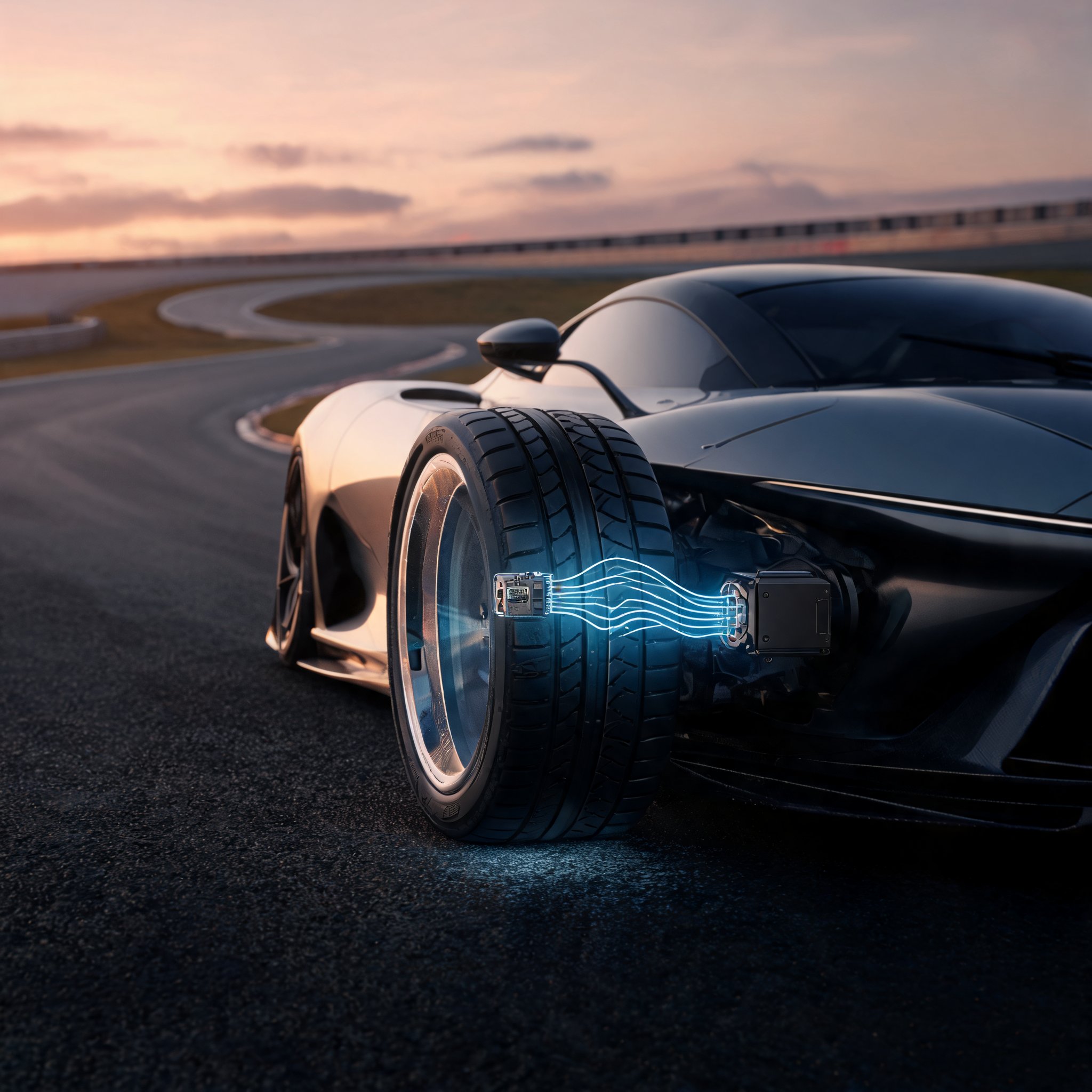
Pirelli is bringing its Cyber Tyre technology to the United States, turning the tire into an intelligent system that can collect data and communicate in real time with a vehicle’s electronic systems.
At Las Vegas Motor Speedway during the Formula 1 Las Vegas Grand Prix, Pirelli Executive Chairman Marco Tronchetti Provera, CEO Andrea Casaluci, Chief Technology Officer Piero Misani and North America CEO Claudio Zanardo demonstrated applications ranging from ABS braking to traction control. Italian Ambassador to the United States Marco Peronaci also attended.
The U.S. introduction follows Pirelli’s announcement of a multi-year investment plan of approximately $1.2 billion in the United States. The investment will fund expansion of the company’s Rome, Georgia, facility, where tires equipped with Cyber Tyre technology will also be manufactured.
Manufacturing program
The Cyber Tyre development is part of a program set to begin in 2027 that will gradually increase the Rome facility’s production capacity to approximately 6 million car tires annually by 2033, while creating approximately 1,000 new jobs. The expansion will include upgrades to Pirelli’s MIRS robotic manufacturing technology and a new, fully automated conventional production line for premium tires. Pirelli says the investments will strengthen Rome’s role as a technology hub serving the United States, which it describes as the world’s largest High Value market, and support its local-for-local strategy.
How the tire communicates
Cyber Tyre transforms the tire from a passive component into a system capable of generating and transmitting data. A sensor inside the tread collects information including tire identification, pressure, temperature and acceleration data. The information is transmitted via Bluetooth and processed in real time using Pirelli’s proprietary software and algorithms, enabling the tire to interact with vehicle electronic systems.
Pirelli cites two main areas of application. In-vehicle integration allows Cyber Tyre to support electronic control systems and advanced driver assistance systems with information generated by tire-road interaction, including early detection of aquaplaning risk. Road infrastructure monitoring uses data collected by tires to help identify potential road hazards and support maintenance planning. Pirelli expects this role to become more important as autonomous driving technology evolves; because the tire is the vehicle’s only point of contact with the road, the company describes the technology as giving the vehicle a “sense of touch.”
Demonstration and first OE application
During the on-track demonstration, Pirelli showed how information collected directly from the tire, processed with proprietary algorithms and translated into specific functions, can be used by a vehicle’s electronic systems. For traction control, Cyber Tyre communicates the tire’s identification to the vehicle’s control unit, allowing the system to adapt settings to the characteristics of the installed tire. For ABS braking, the technology provides data on the tire’s point of maximum grip, helping reduce braking distances. Integration is enhanced through Pirelli’s collaboration with Bosch; information collected by the tire can communicate directly with systems such as ABS, ESP and traction control to help them operate more accurately and effectively in real time.
The Pagani Utopia Roadster was also highlighted as the first vehicle in the world to feature Pirelli Cyber Tyre as standard original equipment. Each tire is equipped with the technology and a sensor that transmits information to the vehicle’s onboard systems. Software integration allows the vehicle to use specific calibrations based on the installed tire and to adjust torque management according to tire type and temperature. The control systems can adapt operating strategies to the tires actually fitted, while the driver receives dedicated information through the infotainment system.