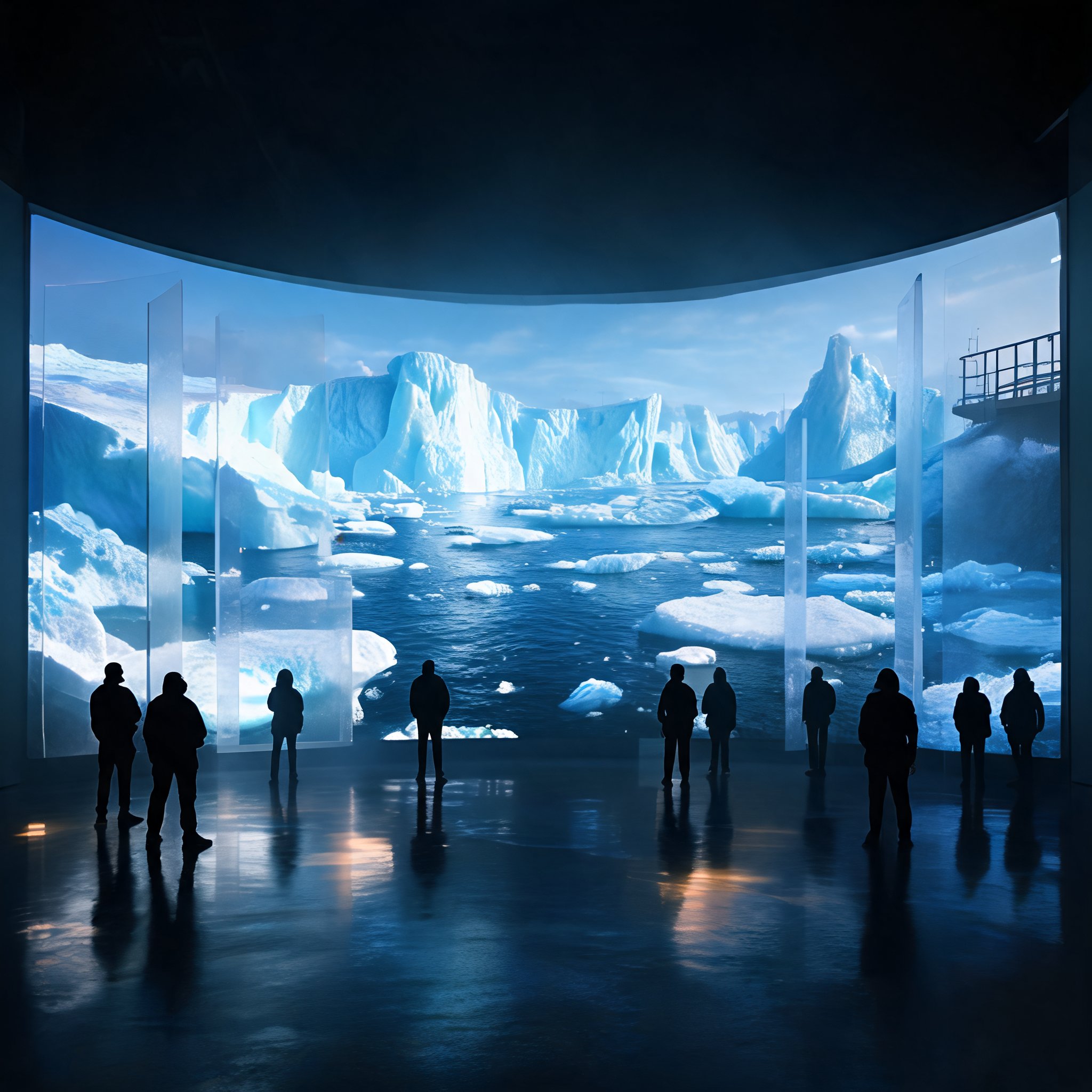
POLAR EXPERIENCE, an immersive exhibition focused on the Arctic and Antarctic, has been designed to turn climate research into a visitor journey rather than a display of facts and figures. The project was conceived by Nicole Srock.Stanley and developed by dan pearlman, with the Alfred Wegener Institute, Helmholtz Centre for Polar and Marine Research, as scientific partner and input from polar researcher Prof. Dr. Markus Rex.
The exhibition casts visitors as members of a contemporary polar expedition. Their route begins at the research vessel Polarstern, where they are received as expedition participants, and continues through representations of frozen landscapes. Along the way, the experience presents ice formations, polar wildlife, the lives of Indigenous communities and scientific missions that have contributed to understanding climate change.
A 360-degree finale and an action-focused close
The journey ends in a 360-degree projection environment that combines large-scale imagery, surround sound and choreographed storytelling. According to the organisers, the aim is to create an emotional connection with the polar regions while keeping scientific accuracy as the foundation of the content.
Rather than relying on fear-based messages, POLAR EXPERIENCE is structured around curiosity and optimism. A final “Act Now” section sets out practical ways for visitors to engage with climate protection, including partnerships and personal contributions. The organisers say the intention is for visitors to leave with both added knowledge and a stronger sense of responsibility.
Accessibility and interdisciplinary development
Accessibility has been treated as part of the design. The exhibition is intended for families, school groups and adults with different levels of prior knowledge. A multilingual audio guide runs throughout the route, while younger visitors are accompanied by Cosmo, a character from Galileo Kids, which is intended to make scientific subjects understandable for children without simplifying the underlying content.
The development process brought together scientists, filmmakers, Indigenous representatives, educators, media partners, designers and immersive technology specialists. Scientific expertise was involved from the earliest stages rather than being added after the creative concept was complete, a process the organisers describe as combining emotional storytelling with scientific credibility.
Berlin premiere draws 120,000 visitors
During its world premiere in Berlin, the exhibition recorded more than 120,000 visitors in four months, according to the project team, and drew praise from audiences and media. POLAR EXPERIENCE is presented by Galileo and Galileo Kids. Local promoters were FKP Scorpio Entertainment in Oberhausen and Cofo Entertainment in Berlin; Seven.One Starwatch, a ProSiebenSat.1 Media subsidiary, was media partner, and GLS Bank supported the project as sponsor. WWF Germany contributed expertise as an NGO partner.
The project is positioned as an example of how immersive media can serve education and social impact, not only spectacle. Its organisers argue that innovation in the format should be measured by the ability to connect visitors emotionally with global challenges and to encourage participation, while retaining scientific trustworthiness.