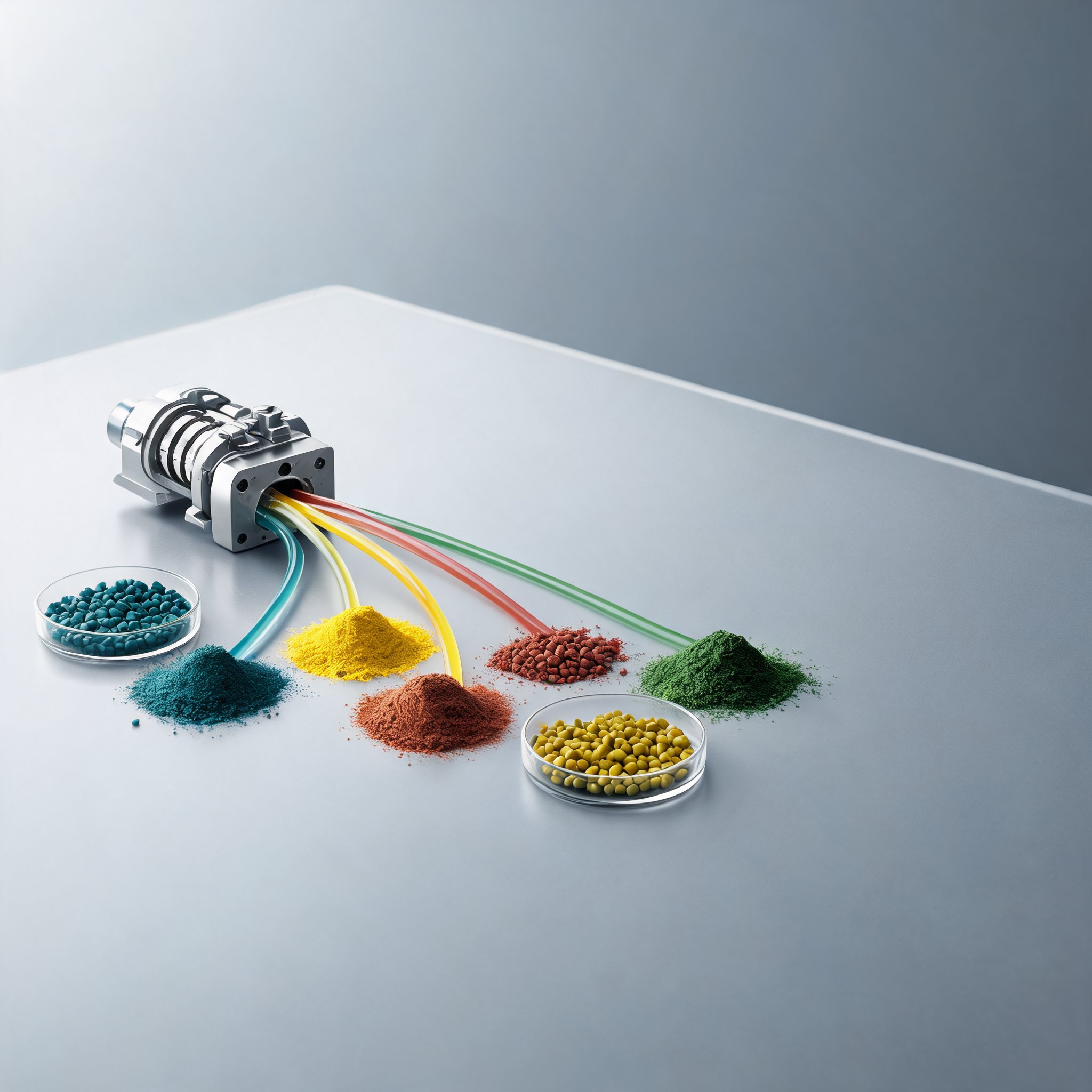
Natural colorants can be compounded into biodegradable polyesters on standard equipment, but they do not yet hold their colour long enough for demanding applications. That is the balance struck by a study titled “Sustainability in the Development of Natural Pigment-Based Colour Masterbatches and Their Application in Biopolymers,” which tested four commercial pigments in polylactic acid (PLA) and polybutylene succinate (PBS).
The pigments were blue spirulina, yellow curcumin, red beetroot and green chlorophyllin. Each was combined with the two polymers to produce colour masterbatches on a twin-screw extruder, then let down into the matching matrix at 2, 4 and 6 wt% and injection moulded into test specimens. The formulation also contained titanium dioxide, calcium carbonate and stearic acid, added to support UV protection, pigment dispersion and processing.
Thermal limits define the process window
Heat is the central obstacle. Natural pigments are organic structures that can begin to break down at temperatures below those at which the host polymers soften and flow. Thermogravimetric analysis put degradation onset at roughly 229 °C for spirulina, 244 °C for curcumin, 258 °C for chlorophyllin and 267 °C for beetroot, while PLA and PBS degrade at considerably higher temperatures.
The team therefore set extrusion profiles that melted each polymer while limiting the pigments’ heat exposure. Processing reached 145 °C for PBS and 190 °C for PLA, with the twin-screw extruder running at 65 rpm and a feed rate of 2 kg/h.
That window suited most pigment–polymer pairs, with one clear exception. Spirulina lost its characteristic blue during PLA processing, so no blue PLA masterbatch could be produced. In PBS, whose lower processing temperature is gentler on the pigment, compounding succeeded. The outcome shows that pigment compatibility is governed as much by a polymer’s thermal requirements as by the colorant itself.
Little disruption to flow or strength
Rheologically, the pigments changed little. Melt flow rate fell slightly after incorporation, indicating a modest rise in melt viscosity. Neat PLA measured about 50 g/10 min, and the natural-pigment masterbatches stayed close to that figure; PBS responded similarly, with only a minor reduction.
For compounders this matters, because a colour system loses its appeal if it forces changes to screw design, pressure settings or moulding conditions. Here, conventional twin-screw compounding and injection moulding handled nearly all formulations without major difficulty.
Mechanical performance held up over the 2 to 6 wt% range. PLA began at a Young’s modulus of about 1710 MPa and tensile strength of 65.6 MPa, PBS at roughly 392 MPa and 34.5 MPa respectively, and the coloured versions stayed near those baselines. Impact strength also remained in a comparable band, though individual pigments introduced some scatter.
Colour retention is the weak link
Successful extrusion did not translate into durable colour. After 50 hours under xenon-lamp exposure, most formulations exceeded a colour difference of ΔE* = 2, the threshold for a visually perceptible shift. The exception was PLA containing 2 wt% of the green chlorophyllin masterbatch, which showed the best photostability of the set.
The authors identify UV stability as the biggest barrier to wider adoption. Packaging, consumer goods, agricultural parts and outdoor products would likely need extra stabilisation, protective coatings or pigment modification before natural colours can match conventional systems over long service lives.
The environmental accounting favours the bio-based route. Under the study’s assumptions, one kilogram of curcumin pigment was linked to about 0.04 kg CO2-eq, against 18.65 kg CO2-eq for the inorganic green reference pigment, and the natural-pigment masterbatches also drew less electricity during extrusion and pelletising.
The conclusion is cautious. Natural masterbatches still need work on lightfastness and thermal stability, but several colorants can be processed into PLA and PBS on existing equipment with limited effect on viscosity and mechanical behaviour. Further development, the authors suggest, should target colour stability both during processing and in service.