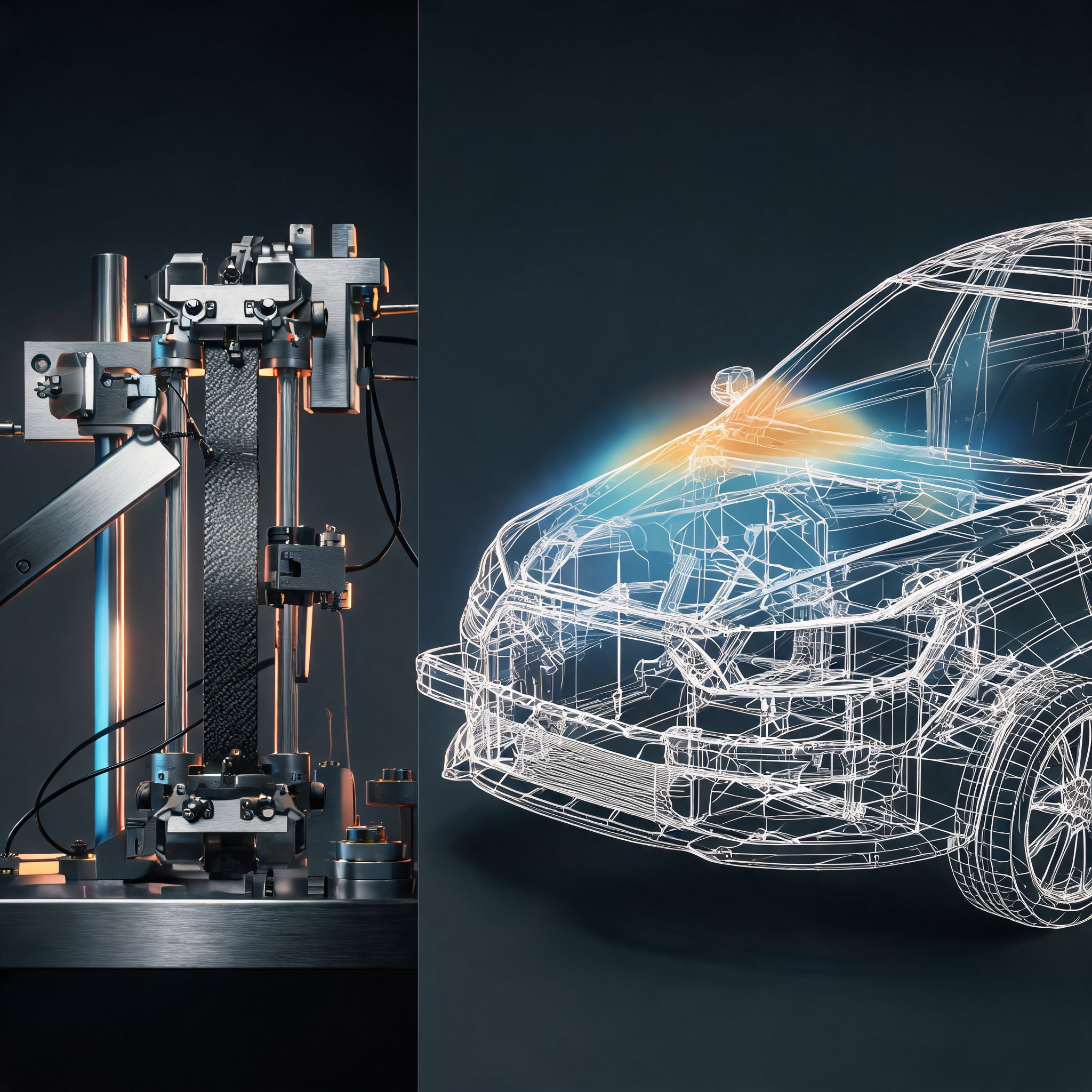
Simulation allows engineers to evaluate a design before committing to a physical prototype, but the value of any prediction depends on how faithfully the material model represents the real material. In an article published by testing machine manufacturer Instron, application engineer and product specialist Andrea Incardona argues that high strain rate testing can supply data that quasi-static characterisation misses.
Incardona's starting point is that many materials are strain-rate dependent: characterised slowly under quasi-static conditions, they can respond differently when loading becomes rapid, as in an impact or crash event. A model built solely on conventional data may therefore fail to represent the conditions a component actually experiences.
A cited study on crash simulation accuracy
Incardona cites a 2025 study in the SAE International Journal of Materials and Manufacturing, titled Influence of Strain Rate Effect on Mechanical and Crashworthiness Properties of CFRP Composite Structures. According to the article, incorporating strain-rate-dependent material properties into crash simulations of CFRP structures narrowed the gap between simulated and experimental results:
- peak acceleration discrepancy fell by 6.5 per cent;
- mean acceleration discrepancy fell by 5.9 per cent;
- displacement discrepancy fell by 6.3 per cent.
On that basis, the article argues that the relevance of material data matters as much as its quantity: where a material behaves differently at higher loading rates, capturing that behaviour gives engineers a more representative basis for simulation.
Range and duration of the tests
According to the article, characterisation can run from quasi-static conditions up to strain rates approaching 1,000/s, depending on the material, specimen geometry and test method. Individual high strain rate tests may last only 3 to 10 milliseconds, which places heavy demands on the data acquisition needed to resolve rapid changes in force and deformation.
Material selection and weight trade-offs
Strength and stiffness measured conventionally do not show how a material will behave once loading becomes fast, and two materials that look comparable in standard tests may diverge at high strain rate. Instron's case is that dynamic data lets engineers compare how candidate materials deform, absorb energy and ultimately fail under conditions relevant to the application. The article points to automotive crash structures and aerospace components, where performance has to be balanced against weight, as areas where that extra layer of information can feed both material selection and component design.
Data capture within the development process
Instron says its high strain rate testing systems support data acquisition at up to 200 kHz, and that digital image correlation can add information about strain development across the specimen, with analysis tools supporting data processing and theoretical modelling. The company frames testing as part of an iterative loop: measure material behaviour, incorporate it into simulation, compare design options and then validate through physical testing. Used earlier in development, the article suggests, dynamic data can help assess whether a material is suitable and refine a design rather than serving only as a final check.
These are the manufacturer's stated capabilities and rationale rather than independently verified results, and the cited study covers CFRP composite structures. The size of the reported gains should not be generalised to other materials without equivalent testing.