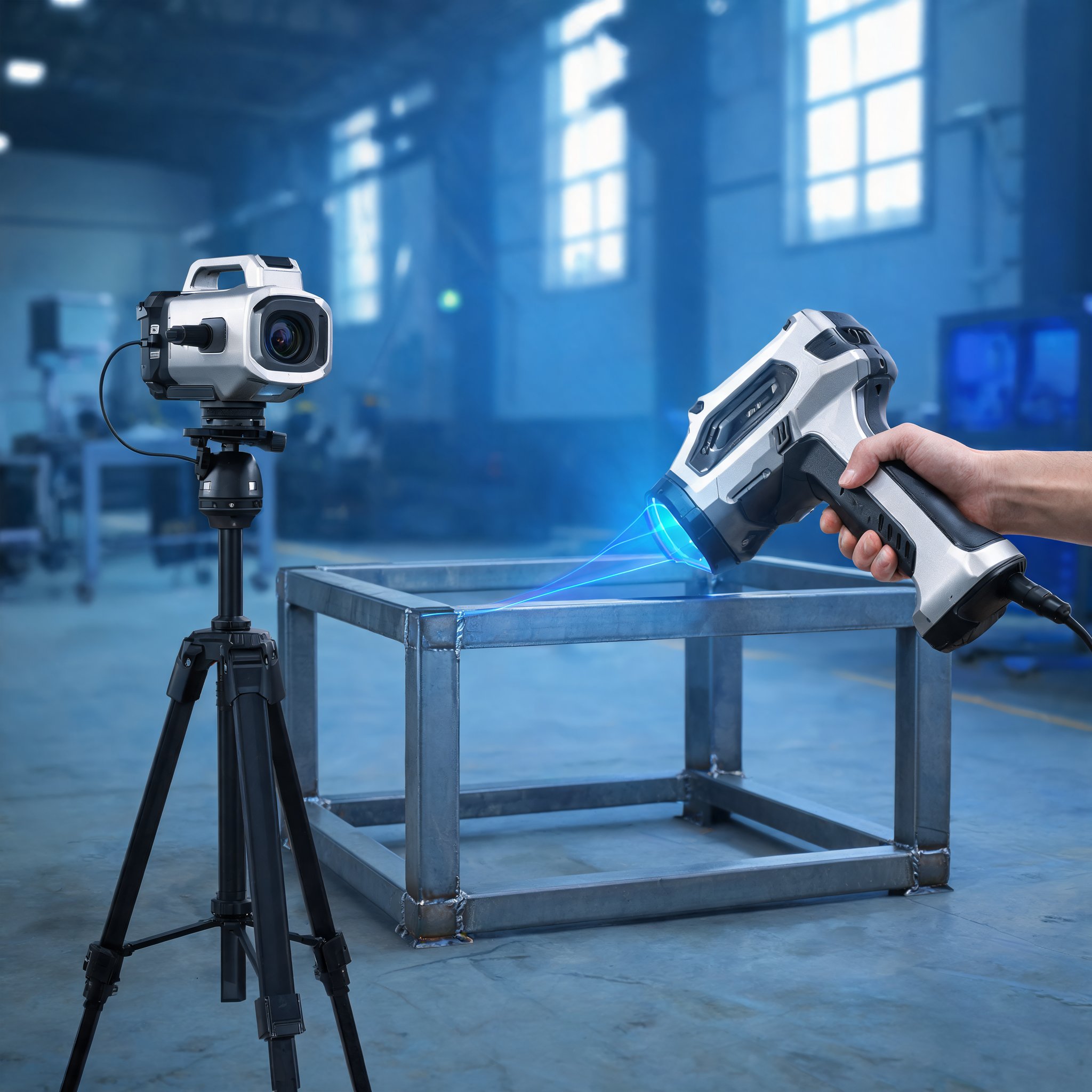
Hexagon has introduced the HYPERSCAN SR, a fully wireless optical tracking 3D scanner designed for industrial inspection in production environments, supplier facilities and field-service locations. The Swedish measurement technology company said the system was introduced on October 12, 2026, and combines WiFi 6 connectivity, swappable batteries and dynamic optical tracking to reduce the preparation that dimensional inspection normally requires. Hexagon adds that inspection teams and field-service engineers can operate the scanner without relying on a dedicated metrology specialist.
The scanner is aimed at small- to medium-sized components, including welded machine frames, cast housings, tooling, fixtures and vehicle interiors. It is intended to let users measure parts where they are located, rather than moving them into dedicated measurement rooms.
Dynamic tracking to counter movement and vibration
HYPERSCAN SR relies on dynamic optical tracking to maintain a common coordinate system between the scanner and the component being measured, which allows the system to compensate for movement and vibration that can complicate dimensional inspection outside controlled environments. Both the handheld scanner and its separate optical tracking unit carry native wireless connectivity and battery power, removing the need for external wireless accessories or cables between the devices. According to Hexagon, the swappable batteries provide up to two hours of operation.
The scanner weighs 1.3 kg without its battery and carries an IP50 rating. It supports scanning rates of up to four million points per second, with multiple modes for capturing surfaces, fine features, edges and holes. It uses blue laser scanning and offers resolution down to 0.03 mm. Maximum tracking distance is 4.2 m, with a tracking volume of 25.9 m³ and a recommended component size range of 0.1 to 6 m. Hexagon specifies volumetric accuracy of 0.06 mm at tracking distances up to 3.2 m, rising to 0.1 mm at the maximum 4.2 m. The system is calibrated in an ISO 17025 accredited laboratory, with measurement accuracy validated according to VDI/VDE 2634 Part 3.
Darren Goh, Product Director for Handheld 3D Scanners at Hexagon, said dynamic tracking makes the system quick to deploy and simple enough for everyday operators to pick up and use. He added that because the scanner is fully wireless, with WiFi 6 and battery power native to the device, teams can bring it into limited-access and power-limited areas that a larger, cabled setup cannot reach.
Software and robotic integration
The scanner ships with Hexagon's HH Scan software, which covers scan data management, alignment, dimensional measurements and inspection reporting. Operators can compare captured geometry against nominal CAD models using 3D colour maps without needing a separate software licence for these basic inspection functions. The system also exports data in STL, OBJ, PLY and other formats, and is compatible with Geomagic Control X and PolyWorks for further inspection workflows, while Geomagic Design X supports reverse engineering and the creation of editable CAD models from scanned geometry. Hexagon notes that its advanced Geomagic packages are licensed separately.
An optional HYPERPROBE contact measurement accessory extends the system to features that are difficult to inspect optically. HYPERSCAN SR also supports Galaxy LEAP referencing, which uses common targets to align measurements captured from multiple tracking positions within a single coordinate system. Beyond handheld use, the scanner can be integrated into robotic measurement systems through Hexagon's standardized integration kit, and these capabilities can support additive manufacturing workflows, including dimensional verification of 3D printed components against their original CAD models.
Position within the HYPERSCAN range
HYPERSCAN SR joins the existing HYPERSCAN Ultra and HYPERSCAN Super as the most mobile model in Hexagon's optical tracking scanner line-up. While the SR reaches up to four million points per second, the Ultra and Super offer rates of up to 8.3 million points per second, and their respective maximum tracking volumes are 50 m³ and 100 m³, suiting larger components and more extensive inspection operations. All three share dynamic tracking technology, common software workflows and support for robotic integration, with the SR positioned primarily for portable inspection while the Ultra and Super target broader production and automated measurement applications. Hexagon said the HYPERSCAN SR is available globally through the company and its reseller network.
The launch extends Hexagon's recent effort to make handheld scanning more accessible. In October 2025 the company introduced the ATLASCAN Pro for small and medium-sized manufacturers, R&D teams and educational institutions, emphasising portability, straightforward operation and compatibility with reverse engineering software. Software integration has also been an area of development elsewhere in the market: in February 2025 Canadian 3D measurement specialist Creaform introduced Creaform.OS and the Creaform Metrology Suite, replacing its earlier VXelements software environment with a redesigned interface, streamlined onboarding and integrated tools for inspection and reverse engineering.