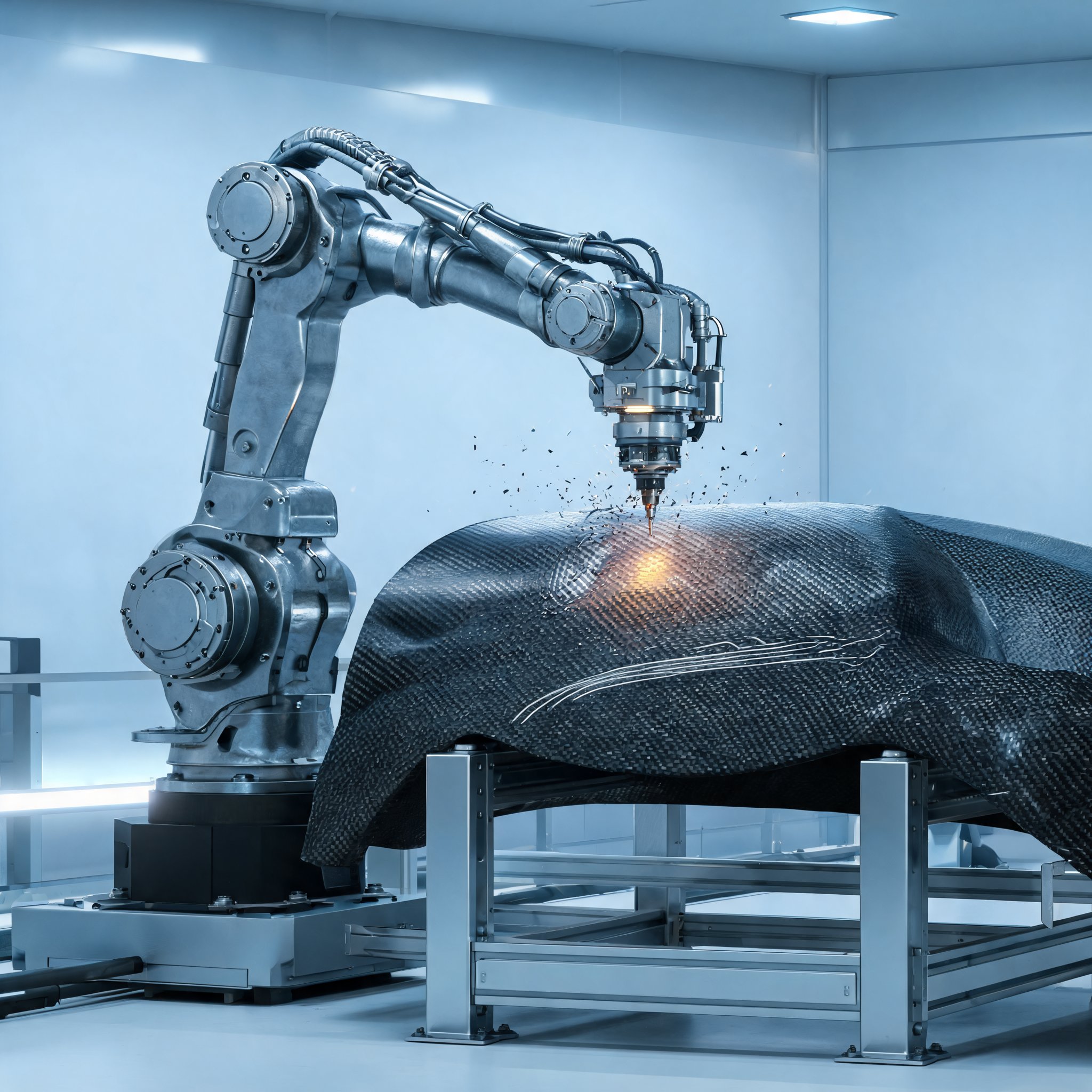
Fives High Precision Machines (Fives HPM) is presenting the Liné Machines RoboTDM as a third option for large-part machining: not a conventional industrial robot, and not a large CNC machine tool. The system mounts a spindle, toolholder and cutter on a robot arm so that milling, trimming and drilling can be taken to the workpiece rather than moving a large component into a machine envelope. The proposition is aimed at applications where the required tolerance is around 0.1 mm, a band in which Fives argues a large CNC machine can carry unnecessary cost and footprint.
The distinction matters because the economics of large-part machining are shaped by part size, setup and programming as much as by cutting speed. Fives says RoboTDM offers quicker setup and easier programming while avoiding the cost and floor-space demands of a large CNC machine. Instead of treating every large part as a candidate for ultra-high precision, the company frames the robot as a way to apply only the accuracy the job needs. The approach is part of Fives HPM's precision at scale cross-brand message and draws on the Liné Machines brand's experience in large-scale milling and material removal.
Where the system fits
Fives identifies a range of operations for the RoboTDM: metal face milling and deburring, including removal of burrs from castings and trimming excess weld beads; drilling pilot holes in large aerospace panels or automotive body parts; and trimming, routing, drilling, edge contouring and pocketing on large composite or thermoplastic fabrications. These are tasks that can be awkward or expensive to put through a conventional machine tool when the part is large, but they do not always demand the precision of a high-end CNC machining center.
The company's core argument is that a robot can be a better fit when the work requires a reliable, accurate way to put a cutting tool in the right place rather than the full capability of a large machine. In suitable applications, Fives says the strategy can deliver advantages in flexibility, cost and cycle time. The robot can be configured with multiple workstations and customized peripheral equipment, and its relatively modest foundation requirements are presented as simplifying installation compared with a large CNC machine tool.
Accuracy is the constraint
Industrial robots have traditionally been limited by positional accuracy. Fives notes that conventional systems typically achieve tolerances of around 0.3 mm, which is insufficient for many machining applications. The RoboTDM development work therefore focused on closing that gap through high-precision robotic machining. The company says robot calibration techniques, together with advanced look-ahead and motion-planning algorithms, allow programs containing more than one million points to be processed without the latency that can otherwise compromise robot motion.
According to Fives, the result is smoother trajectory execution that supports multi-axis contouring and complex machining in a way more closely comparable with CNC machining. The company says RoboTDM can reduce machining deviation by up to 100 μm, or 0.1 mm, a threefold improvement over conventional robotic accuracy. That claim defines both the opportunity and the boundary: the system is positioned for work where tolerances down to approximately 0.1 mm are acceptable, not for jobs that require tighter precision. Fives explicitly says that where tolerances tighter than 0.1 mm are necessary, a high-precision CNC machine remains the appropriate choice.
Tooling and process flexibility
The machining end effector can be configured with different spindle sizes, power ratings, torque and speed. Available systems can provide spindle power up to 125 kW, torque up to 80 Nm and speeds reaching 30,000 rpm, with HSK A63, HSK F63 or HSK A100 taper toolholders. That range allows the same robotic platform to be matched to different material-removal tasks rather than fixed at a single cutting specification.
Fives also says RoboTDM can incorporate automatic tool changing, tool measurement, tool-breakage detection and part probing, while a vision system can support drilling applications. The robot is not limited to machining: the system can be configured for waterjet cutting, laser profiling and ultrasonic cutting. This modularity is central to the commercial case. A manufacturer can combine a robot, a process package and peripheral equipment around the part, rather than committing to a single large machine tool and the building and foundation work it may require.
Evidence and limits
Fives points to a multi-year R&D project and development trials that demonstrated cycle-time reductions of up to 70% in trimming and milling, with some individual applications achieving even greater savings. Those figures are company-reported development results, not a guarantee for every part. The relevant question, as Fives frames it, is whether an application actually needs a large CNC machine or simply needs a reliable and accurate way to position a cutting tool. The answer will depend on tolerance, part geometry, access, programming effort and the amount of process integration required.
The system's physical flexibility is particularly valuable for components too large or awkward to justify moving through a conventional machine tool. Fives sees particular appeal in aerospace, defense, maritime and energy, where component dimensions can be substantial and production requirements vary considerably. The company also notes that RoboTDM is complementary to Liné Machines and the wider Fives HPM portfolio of high-precision machine tools, rather than a replacement for all CNC machining.
Fives Liné Machines Inc, now part of Fives HPM, has had a North American presence for almost 50 years through its facility in Granby, Quebec, Canada. The plant produces Liné CNC machine tools and robotic solutions, including RoboTDM, and supports engineering, integration, automation, service and training across equipment lifecycles. For manufacturers weighing conventional robotics against a large CNC machine, the system's significance lies in that middle ground: lower capital investment, simpler installation and greater flexibility are potential benefits, with the 0.1 mm tolerance band marking where the argument begins and ends.