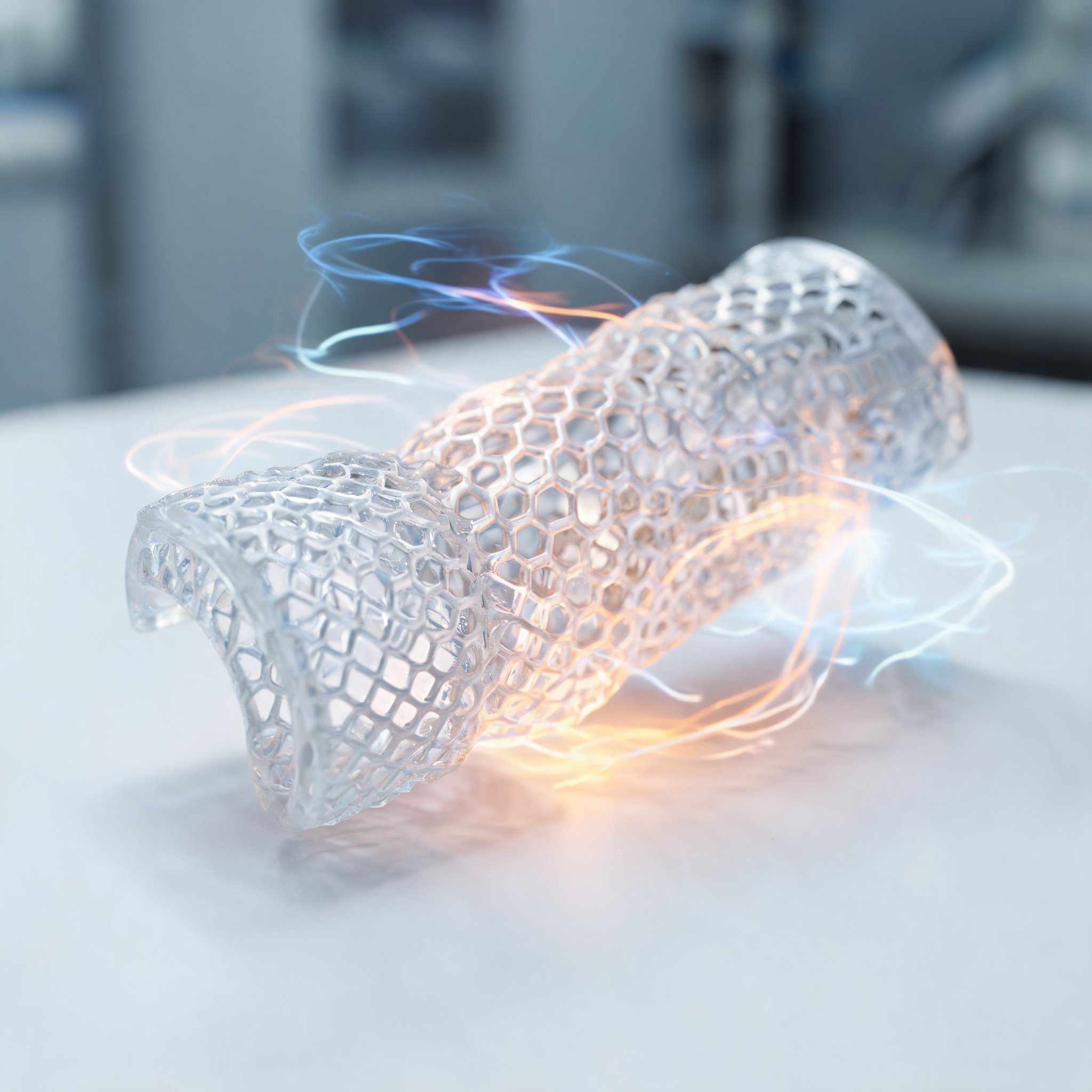
Meisam Abdi, a researcher at De Montfort University Leicester, has received a 2026/27 Royal Academy of Engineering/Leverhulme Trust Research Fellowship to investigate whether 3D printing can produce artificial muscles for soft robots.
He is one of eight engineers in the UK to receive the award. The fellowship funds up to a year of research into materials and structures that could allow robots to move, sense and respond more like living organisms.
Designing properties through geometry
Abdi's starting point is not a replica of human muscle. His project will use additive manufacturing to create architected structures whose geometry supplies specific properties. The work will compare combinations of piezoelectric, conductive and structural materials and architectures, model them with computer-aided engineering, print them, and test their response to electrical stimulation in the laboratory.
Piezoelectric materials are central because they can convert mechanical deformation into electrical energy and deform when an electric field is applied. According to De Montfort University, existing high-performance piezoelectric materials are often stiff and brittle, while some of the most widely used types contain lead. Those characteristics complicate the development of artificial muscles that need to be soft, flexible and more sustainable.
To address that tension, Abdi plans to combine material composition with specially designed 3D-printed cellular structures. The goal is to obtain the required properties while retaining softness and flexibility, rather than depending on a conventional bulk material.
Multiple functions, one structure
The longer-term aim is an artificial muscle that can produce movement, sense its environment and harvest small amounts of electrical energy from mechanical movement or vibration. That combination reflects the appeal of biological systems, which integrate movement, sensing and responses to external stimuli. Abdi's question is whether a manufactured structure can reproduce some of those functions.
He is not seeking to copy an existing natural form. By varying materials and geometry, the project will examine whether printed structures can exhibit properties that do not currently exist naturally.
Abdi calls the project ambitious. Research into soft robotics is already substantial, but creating a structure that begins to replicate several functions of living muscle remains a major challenge. His immediate objective during the fellowship is a prototype that demonstrates what is possible and provides a foundation for further work.
The project's progress will therefore be judged on more than the ability to bend or flex. It must show whether a printed architecture can bring together actuation, sensing and energy harvesting while preserving the compliance that makes soft robots useful in close human environments.