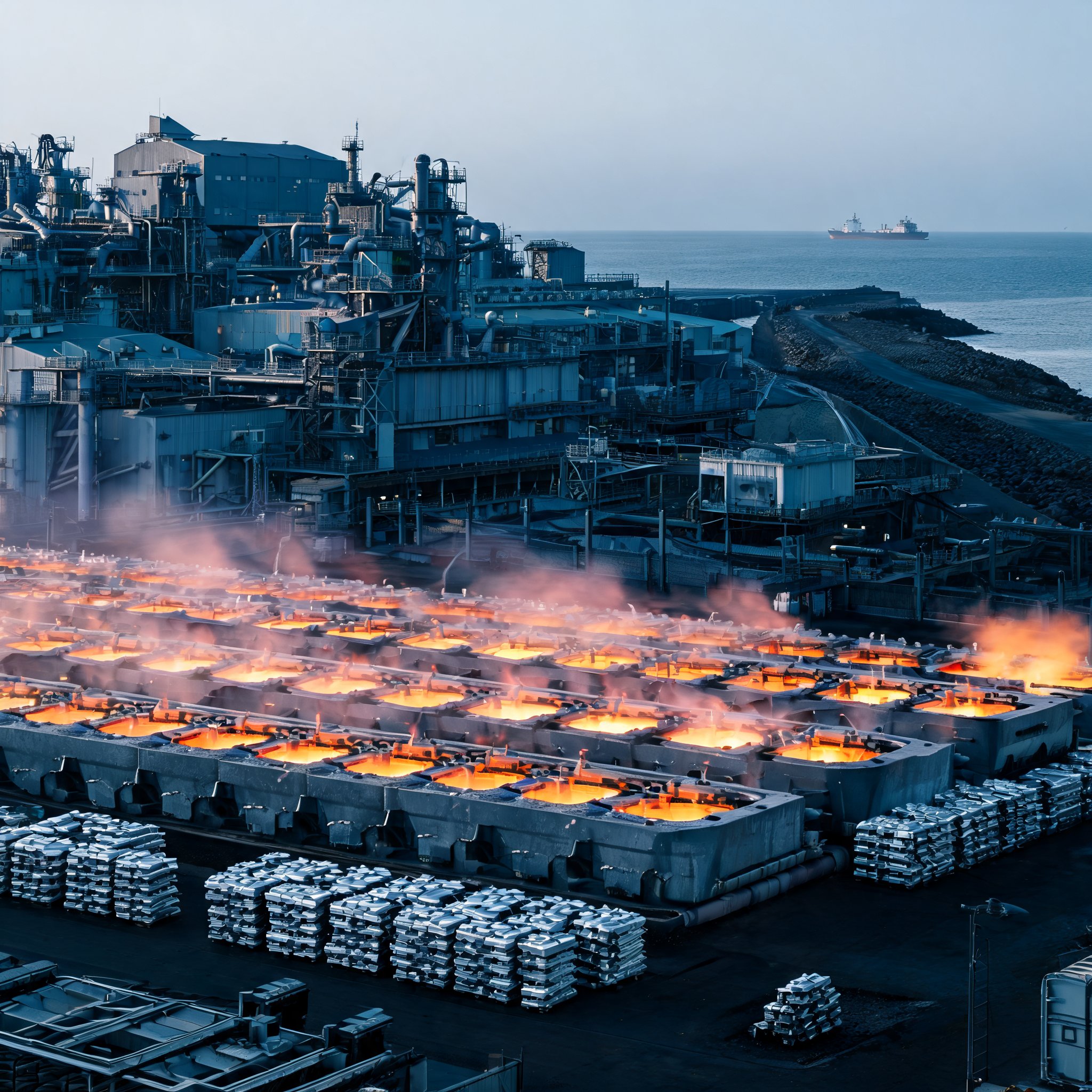
Aluminium Bahrain B.S.C. (Alba), described by the company as the world's largest aluminium smelter on a single site, reported a 72.5% year-on-year fall in profit attributable to equity holders to BD18.5 million (USD49.3 million) in Q3 2026. The result compared with BD67.3 million (USD178.9 million) in Q3 2025 and came as lower production availability and regional shipping and logistics disruptions weighed on the quarter.
Basic and diluted earnings per share were 13 fils, down from 48 fils a year earlier. Total comprehensive income attributable to equity holders fell 69.6% to BD20.5 million (USD54.5 million), from BD67.5 million (USD179.4 million). Alba said operational stability improved during the quarter.
Nine-month profit rises despite weaker volumes
The quarterly decline contrasted with Alba's first nine months. Profit attributable to equity holders rose 44.3% year on year to BD158.7 million (USD422.1 million), compared with BD110 million (USD292.4 million). Basic and diluted earnings per share improved to 112 fils from 78 fils. Total comprehensive income for the period increased 51.8% to BD161.1 million (USD428.4 million), from BD106.1 million.
Alba's balance sheet also strengthened. Total equity attributable to owners reached BD2,183.6 million (USD5,807.4 million) at 30 September 2026, up 4.8% from BD2,084.6 million at 31 December 2025. Total assets rose 9.8% to BD2,880.1 million (USD7,659.8 million), from BD2,623.3 million.
Controlled shutdowns cut output and sales
Operational data showed the effect of regional disruption and production adjustments. Sales volume reached 800,792 tonnes in the nine-month period, down 33% year on year, while net finished production fell 41% to 709,395 tonnes. Alba attributed the lower output mainly to the controlled shutdown of Reduction Lines 1, 2 and 3 amid regional disruptions. Shipping and logistics challenges also constrained its ability to maintain usual sales volumes.
Value-added products accounted for 67% of total shipments. VAP sales were 532,591 tonnes, down 41% year on year, as Alba maintained its focus on a value-added product mix despite lower overall volumes. The company said it progressively restored production capacity in Q3 2026 after controlled adjustments to address raw-material constraints. It added that disciplined alumina management and supply-chain planning helped protect smelter stability and asset integrity, while Reduction Line 4 continued towards full ramp-up.
Global market remains tight
Alba's market assessment pointed to supportive aluminium fundamentals. Global demand grew about 1% year on year, helped by automotive, solar, renewable energy and power transmission. China demand rose about 4%, while Europe and the US declined about 1% and 8% respectively amid weakness in construction-related activity.
Global aluminium production contracted about 1%. Output outside China fell 6%, outweighing 3% growth in China, where the capacity ceiling constrained production. The global market remained in deficit by about 485,000 tonnes, including a deficit of about 108,000 tonnes outside China. LME aluminium prices averaged USD3,226 per tonne in Q3 2026, up 23% year on year, while LME inventories fell 53% to 241,000 tonnes. Regional premiums strengthened, supported by physical tightness and shifting trade flows.
Priorities for 2026
Alba expects constrained supply and low inventories to support aluminium prices, though macroeconomic and geopolitical developments may create near-term volatility. It expects supply availability to improve as Gulf smelter restarts progress and Indonesian capacity ramps up, while China's capacity ceiling limits additional supply. The company's 2026 priorities include restoring capacity, completing the ramp-up of Reduction Line 4, protecting smelter stability and asset integrity, and strengthening supply-chain resilience. Longer-term plans include progressing the proposed Aluminium Dunkerque transaction through remaining approvals and advancing construction and commissioning of Alba-Daiki Sustainable Solutions. Alba also plans to continue its decarbonisation programme and retain a differentiated, value-added product mix.