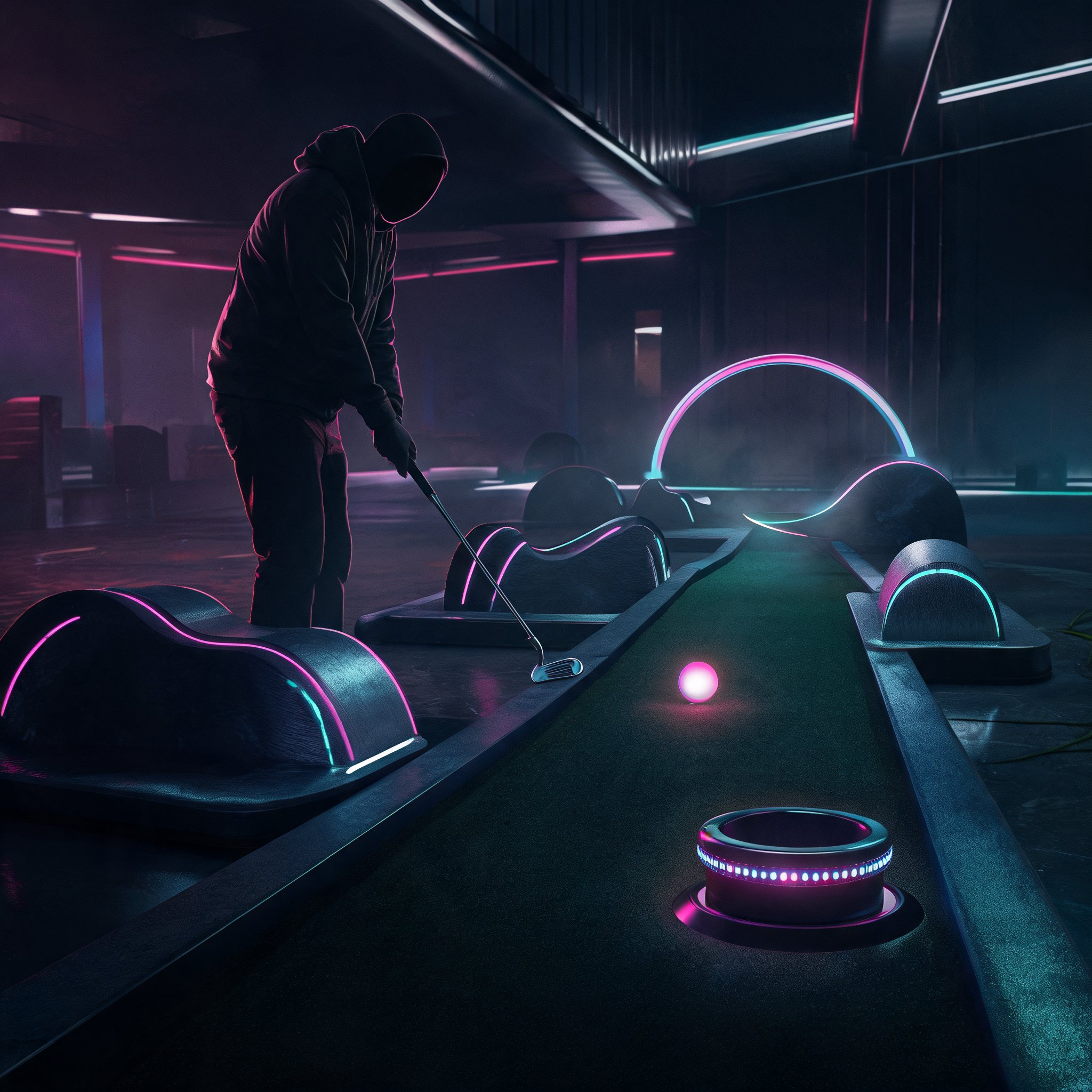
360Golf, the mini golf brand developed by experience design company Holovis, is being sold as a connected gaming platform rather than a course: automated scoring, layered gamification and an analytics engine are packaged together so operators can retrofit an existing attraction, buy ready-made holes or commission a bespoke build. The team is presenting the offer at the Land Leisure & Tourism Show at NEC Birmingham on 4–5 November and at IAAPA Expo in Orlando on 16–20 November, where a playable demonstration is available at the company's Orlando office nearby.
Holovis says implementations now span the UK, Europe, the Middle East, North America and Asia Pacific as the competitive socialising sector continues to expand. Its argument for standing out in a crowded market is counter-intuitive: the format's familiarity. Stuart Edgington, global director of business development, says mini golf is already one of the world's most accessible leisure activities, so the fundamental appeal does not need reinventing; the technology is built on top of it to make play more competitive, more interactive and more commercially measurable.
Access is deliberately low-friction. Visitors of all ages register, collect an assigned smart ball and start playing, so the platform needs little explanation or staff time. Edgington adds that operators are actively seeking activities with intergenerational appeal, and that a single course can draw families, competitive-socialising young adults and corporate groups, making it an anchor attraction.
Scoring first, gamification second
The base layer is automated scoring. Smart balls, tees and cups work with the HoloTrac scoring system, removing paper scorecards and acting as referee when matches get close. Project manager Maaz Ussen describes the resulting layer of technology as sophisticated but effortless for the guest.
On top sits a suite of gamified features: SuperShots that offer alternative ways to score, Triumphs that hand out awards and unlock new challenges, plus bonuses, on-course games, player accounts, achievements, leaderboards and video celebrations. Business development director Matt Dobbs frames the purpose as giving players more reason to compete, to celebrate and to compare scores afterwards — and therefore more reason to return.
Analytics as an operating service
Those interactions feed DeepSmarts, an AI analytics engine that Holovis uses both to shape product development and to sell services to clients. Edgington lists higher uptime, insight into how players behave, seasonality patterns and prompts for operational adjustments as the outputs, offered as an add-on layer. The same data has shaped a design optimised for dwell time and secondary spend, with capacity of up to 80 people per hour per course.
The commercial logic is staffing. Dobbs argues that a kiosk-driven flow — understand the game, collect a ball, play — lets the operational team concentrate on hosting guests and selling food and drink, and that happier guests spend more, with F&B revenue as the ultimate target. Analytics also support promotions aimed at quieter periods or under-served audiences. Maintenance is designed to be repairable and long-lived, and when something goes wrong, Ussen says engineers can review incidents remotely rather than travel to site.
From retrofit to fully custom
Delivery is split into three routes with different lead times:
- Technology-only packages retrofitted into existing mini golf venues, typically installed in six to eight weeks.
- Catalogue holes from a tried-and-tested range, installed and playable in eight to 12 weeks.
- Fully bespoke courses, which can take six months or more.
Recent projects illustrate the spread. The Top 9 course at Netflix House is a fully custom, IP-led build with unique hole designs and multiple interactive elements, drawing on themes including One Piece, Squid Game and Floor is Lava. Tee Time for Norwegian Cruise Line, installed four times, uses marine-grade components and IP-rated technology — rugged cups and tees, specialist screens — to deliver the same experience at sea. Super Social in Leopardstown, Ireland, took 12 holes from a sports-themed package, while Butlin's £15m PLAYXPERIENCE centre in Bognor Regis, opened in 2024, houses three nine-hole courses: a neon glow layout, a Las Vegas-themed challenge and a wheelchair-accessible music-themed course. Dobbs says the venue has handled around 5,000 players and roughly £40,000 of revenue in a busy week, ahead of the client's expectations.
Consistency across sites, and smaller footprints
For multi-site operators, the platform is pitched as a way to hold a standard while varying execution. Edgington says clients such as Saudi Entertainment Ventures (SEVEN) can keep core technology consistent and then vary theming, layout or branding, with sites networked together. Because scoring and dynamic gameplay reward repeat visits, he argues the model fits large-scale developments and operators chasing return custom. Smaller venues get a cheaper, simpler physical design, but the scoring, replayability and core product remain, which the team sees as a route for operators building toward a chain.
Inclusive design and other sports
The Butlin's work pushed the team into inclusive design, which Ussen describes as highly nuanced: courses playable right- or left-handed, putters sized for taller guests, a drop-down top cap so a wheelchair can get close to or onto the course, tees kept near the edge where reach is limited, and enough spacing between holes to limit crowding and safety hazards. New projects include Lucky Duck in Norway, a custom course where each hole offers two routes, adding a dimension of play and using space more efficiently. Holovis is also working with Roxy Leisure to add stroke counting to crazy pool tables — part of a stated ambition to apply the technology to other sports.
Edgington expects competitive socialising to reach peak saturation eventually and says the company is examining adjacent markets. Product development, meanwhile, is aimed at simplification and engagement: using collected data to understand what guests respond to, and finding ways to occupy them while they wait — predicting the highest scorer, for instance, in the manner of a fantasy football league — with AI positioned to make those features more dynamic.
What operators are asked first
Dobbs says conversations start with the venue and its restrictions, then the audience: whether the target is young adults on Friday and Saturday nights, or a mix that must also serve children and grandparents. Commercial modelling and the support behind it follow. The framing is a turnkey offer rather than the sale of a course, which is also how the company describes its trade-show pitch in Birmingham and Orlando.